
Blogging for Home Care Agencies & How to Start
September 9, 2026 · KGY Digital · 18 min read

While it’s common for some to overlook it in their marketing strategy, blogging for home care is a one of the most powerful and cost-effective tools for online lead generation.
Blogging for Online Lead Generation
The people and companies behind the 600 million+ blogs on the Internet (a) are not doing it simply for the joy of writing. Rather, they’ve discovered that it’s a secret to driving traffic to their website, which often results in paying customers.
If you want to learn how blogging can help you in your business, read on or feel free to jump to a section that interests you most:
Blogging Can Help Increase Revenue & Influence
Gone are the days when a blog was merely seen as a digital version of a personal diary. Nowadays, blogs are used as a way to:
- Drive traffic to websites
- Demonstrate expertise & authority,
- Boost search engine rankings
- Earn additional income through affiliate marketing
Apart from the expense of hosting your website (which you’re probably already paying) a blog is a cost-free marketing tool that holds immense potential to impact the success of your small business.
In this comprehensive guide, we delve into the subject of blogging for home care, exploring its benefits, strategies, and then teach you how you can start blogging like a pro for your business.
4 Benefits of Blogging for Home Care
1) Gaining Free Traffic from Search Engines
People search the Internet for just about everything. From product research, to reviews, to visual comparisons, your potential customers are looking for information, and the good news is that you probably have it.
When a person, for example, searches Google for “How to Choose the Best Home Care Agency,” chances are, they’re in the market for a good, trustworthy company that provides excellent care services for elderly or disabled individuals.
When Google is delivering search results, it scans the internet for the best, most relevant content to answer the user’s question. If a local Home Care Agency has a well written article entitled “How to Choose the Best Home Care Agency,” chances are their article will be among the results served to the folks typing this term in a search engine.
The benefit of having a blog is you can write on topics that respond to the questions that your potential clients need answers to, and in turn, position yourself to harvest search engine traffic to your website.
Once they land on your website, provided you have a good call-to-action inviting users to further engage with your business, you will ultimately turn searchers into leads, who eventually become clients.
Blogging on your own website offers an avenue to consistently create opportunities to win valuable traffic made up of folks who are actively looking for what you provide. This is why a robust website is non-negotiable for small businesses.
Learn about our Home Care Agency Websites Starting at $995 setup
2) Increasing Your Company’s Credibility and Authority
Becoming a trusted voice and thought leader in an industry is something most business owners would love. Fortunately, such coveted acclaim is now within reach for us ordinary folks. By consistently publishing strong, informative content, you can position yourself or your business as an expert in your industry and gain increased trust in your opinions and recommendations.
Using the Home Care Agency example as before, let’s say you’re an agency located in The Woodlands, TX. In order to position your agency as an authoritative voice especially in the local area, you will need to consider the topics that your potential clients might visit the Internet to find answers to.
Blogging on “Things to do for Senior Citizens near The Woodlands, TX” can likely result in local search engine traffic from people that match your target audience.
In addition, each article can become a useful resource that you can also send to clients and families when they ask related questions.
Blogs allow you to delve into topics, and offer solutions to common problems, demonstrating a deep understanding of home care, and setting you apart from competitors.
SEO Value – Search Engine Optimization
Now let’s talk about the significant SEO benefits that blogging offers, and why it’s among the most popular methods to boost your website’s visibility and authority. High-quality, regularly updated blog content gives search engines fresh material to index, increasing the chances of your site being discovered in relevant searches.
By strategically incorporating target keywords into your blog posts, you can improve your website’s ranking for those terms. (Keep reading to learn how to discover these keywords).
Each new post provides an opportunity to create internal links to other pages on your site, improving its overall structure and making it easier for search engines to crawl and index your content. Additionally, as readers engage with and share your blog posts, it signals to search engines that your content is valuable and authoritative, potentially leading to higher rankings.
Over time, a well-maintained blog with a robust archive of keyword-rich posts can significantly enhance your site’s SEO, attracting more organic traffic.
Monetization through Affiliate Links
I know what you may be thinking…. “Is this turning into some get rich quick scheme?”
Not at all! Affiliate marketing is actually legit.
While many people portray affiliate marketing as a shortcut to overnight riches, the truth is far more nuanced. Monetizing your small business blog through affiliate links can indeed generate income, but it requires strategy, patience, and ethical practices.
Affiliate marketing involves partnering with companies and promoting their products or services on your small business blog. When your readers click on these affiliate links and make a purchase, you earn a commission. However, success in affiliate marketing hinges on authenticity and trust.
Instead of bombarding your audience with random affiliate links, focus on promoting products or services that align with your niche and genuinely benefit your audience.
By providing valuable content and recommending products you believe in, you build trust with your readers and increase the likelihood of earning commissions through affiliate marketing.
Remember, it’s not a get-rich-quick scheme, but with dedication and integrity, affiliate marketing can be a very lucrative monetization strategy for your small business blog.
How to Start Blogging & Do it Successfully
Now it’s time to learn how to become a small business blogging superstar! But before typing a single word, it’s crucial to understand who you’re writing for.
Choose Your Target Audience & Create Buyer Personas
The most successful businesses take the time to define their target audience, and to develop detailed buyer personas.
Buyer personas are highly specific definitions of who your typical customers are. Effective buyer personas incorporate fictional characters to assist the internal marketing team in visualizing the target audience. Creating buyer personas helps guide your content creation process by helping you keep your audience in mind when developing content.
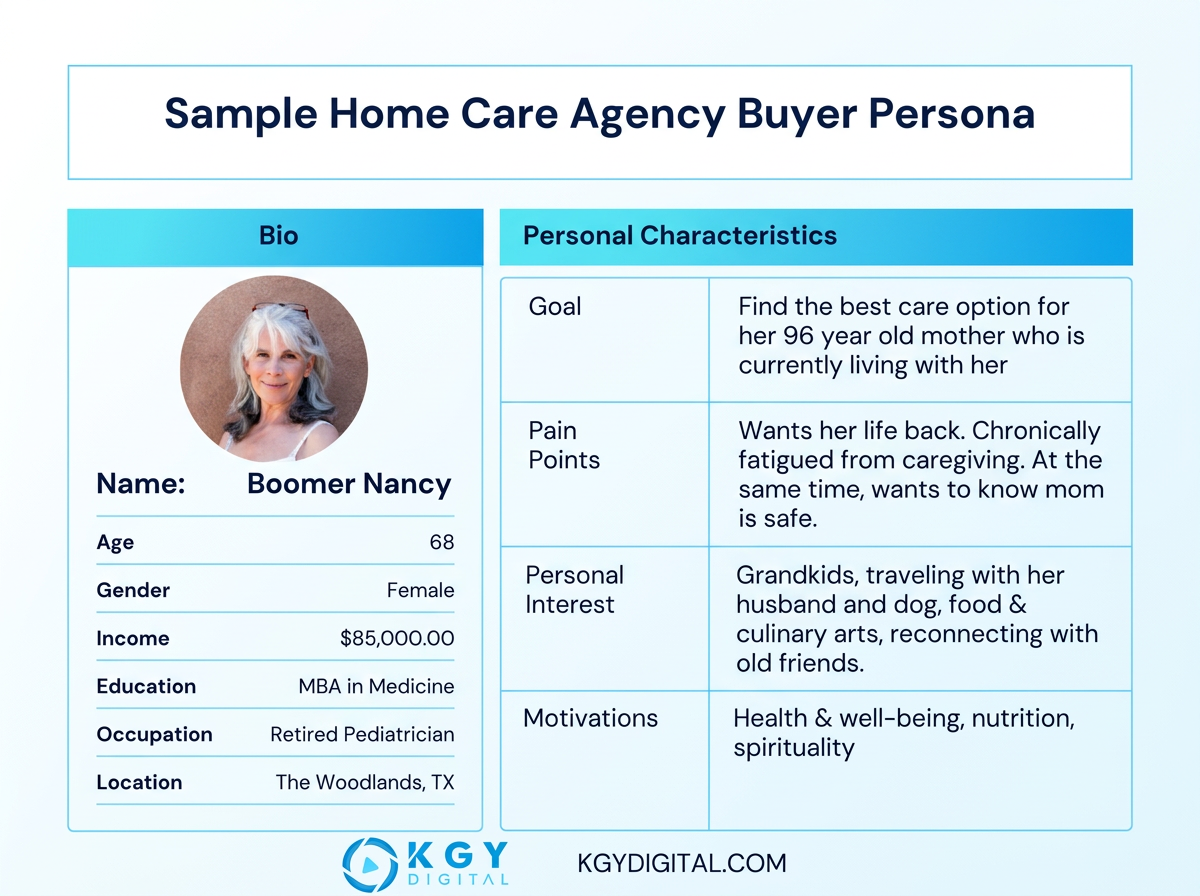
When defining buyer personas, dive deep into defining their demographics, such as age, gender, location, and income level. Answer key questions such as what are their pain points, interests, and preferences? Understand their motivations and challenges so that you can craft blog posts that speak directly to their needs.
Above is a sample buyer persona that could apply to our example Home Care agency business. Tailoring your blog posts to resonate with a specific audience ensures relevance and increases the likelihood of creating a following that’s made up of potential buyers.
For instance, if your business is targeting families who are seeking care for their elderly relatives, your content might focus on topics such as “Signs Your Aging Parent Needs a Professional Caregiver,” “When an Elderly Parent Refuses to Take Medication” or “How to Navigate Medicare for Senior Care.”
This level of personalization not only attracts readers but also fosters a sense of connection and loyalty.
Choose Your Topics: Conduct Keyword Research
Keyword research is a critical aspect of a successful blog for your business. Essentially, keyword research involves identifying the specific words and phrases that your target audience uses when searching online for information related to your services, or when browsing the web in general. In the case of our Home Care Agency, this means understanding the search terms that, for example, families of senior citizens (or seniors themselves) might use when looking for care services, or related information.
To begin, you’ll want to utilize keyword research software such as Google Keyword Planner, a free tool which we will go over in the next section. If you want to take your keyword research and overall SEO to the next level, you can invest in an advanced tool such as Semrush. Semrush is one of the most reputable tools helping businesses win with SEO. This premium software shows you where you currently rank against your competitors, provides insight on your daily positioning and much more.
However, Google’s keyword planner will provide you with enough insight to find the keywords you need for your content. Here’s a mini tutorial on how we can use Google Keyword Planner to find topics for a home care agency, and the same steps apply to any business.
Using the Google Keyword Planner
Access the Google keyword planner. Make sure you’re logged in to the Google account that you use for your business. If you don’t have a Google Account, go ahead and create one as you will need it for several key types of digital marketing activities. You may be prompted to enter billing information but don’t worry, Google will not charge you anything unless you decide to start running ads. Once you have entered the requested information, you should see a screen that leads you to the keyword planner.
Click on “Discover New Keywords” to start using the keyword planner.
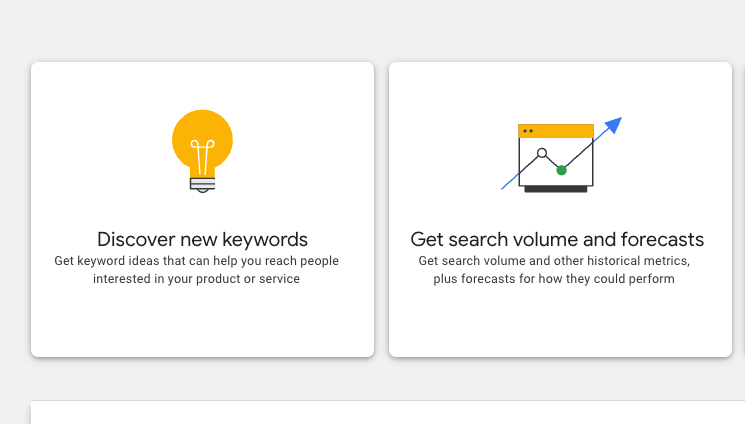
Enter Seed Keywords
In the search box, enter some keywords or phrases related to your business’ services. For our Home Care Agency example, keywords might include “elderly care,” “senior care services,” “in-home care,” “respite care,” and the like.
Review the Results
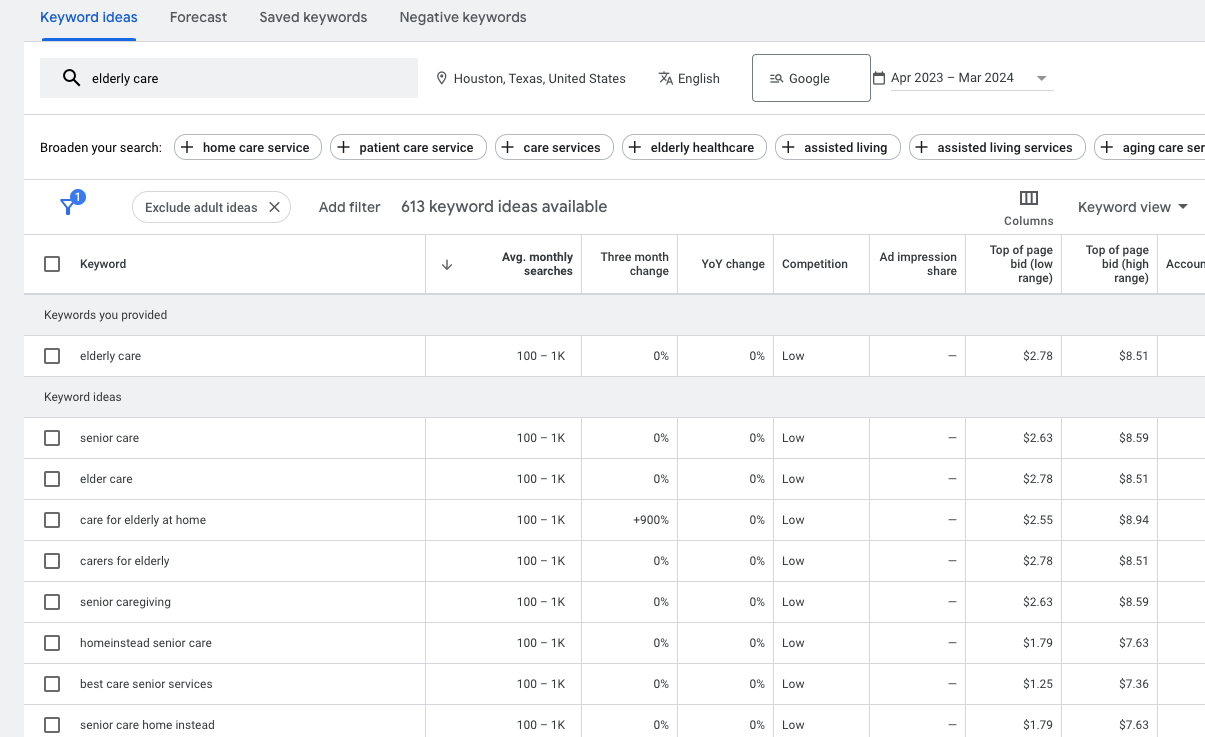
Keyword Planner will generate a list of keyword ideas based on the seed keywords you entered. This list includes average monthly search volume, competition level, and related terms. For example, you might see terms like “24-hour home care,” “senior home health care,” or “dementia care services.”
Analyze Search Volume and Competition
You can sort by the “volume” column to analyze the search volume of these keywords and see how many people are searching for them each month. Higher search volume generally indicates more potential traffic but also higher competition. Lower volume keywords may be easier to rank for but might attract less traffic.
Filter by Location
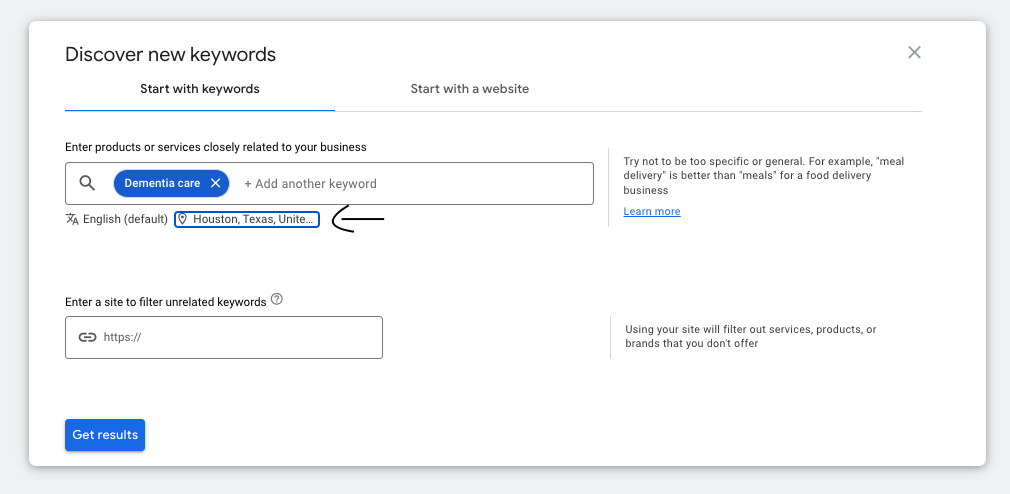
Keyword Planner allows filtering by various criteria such as location which is very important for companies looking for customers in their local area versus nationwide. Other filters include language, and keyword options. Narrow down the list to focus on keywords most relevant to your services and location.
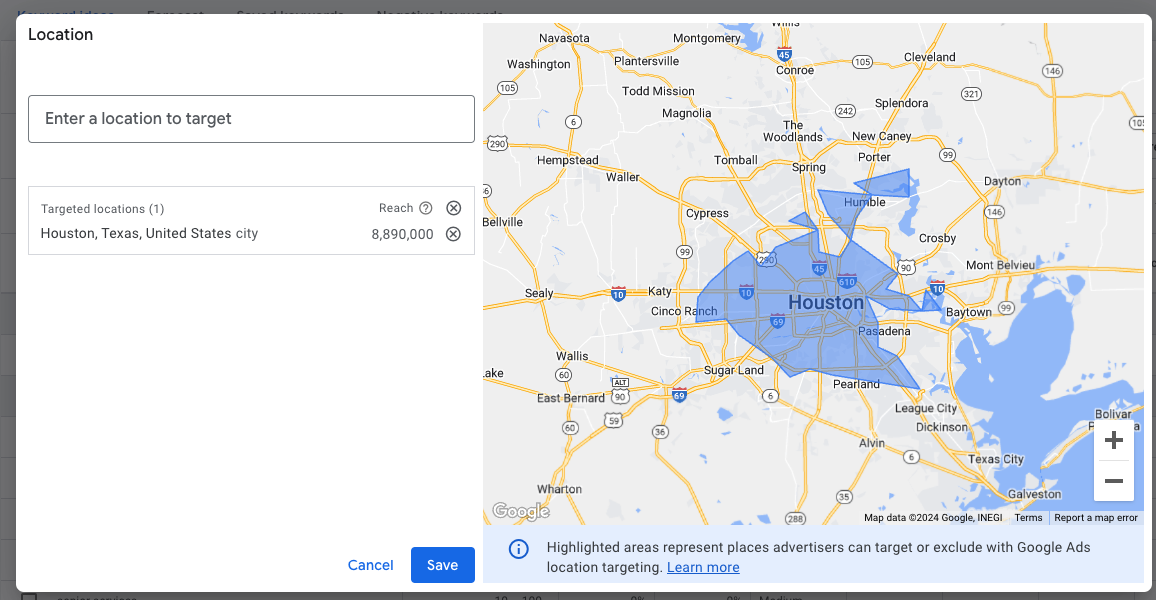
Pro-Tip: If you want to only target your city, make sure to remove the default location Google provides (which is usually your country). In our case, we removed “United States” by clicking the “x”, and kept only “Houston, Texas”
Long-Tail Keywords
Consider long-tail keywords, which are longer and more specific phrases. These often have lower search volume but can be highly targeted. For example, “home care services for Alzheimer’s patients” or “respite care for elderly in [your city].”
Create a Keyword Strategy: Based on the keyword research, develop a content calendar with topics focusing on these keywords. For example, create blog posts around “tips for managing medications at home,” “activities for seniors with dementia,” or “how to find affordable senior care services.”
By conducting thorough keyword research using tools like Google Keyword Planner, your small business can uncover valuable insights into what your target audience is searching for.
Write Your Blog Post & Include Your Keyword(s)
Once you’ve completed keyword research, it’s time to write your article, and strategically integrate the keyword(s) you’ve selected for the article into your blog posts. Open a blank Google Doc, or Word Document and begin by creating a bulleted outline. Starting with an outline helps you gather your thoughts and consider the main points that you want to cover in your article.
Working with AI
In these days of the AI revolution, you can now make the blog writing process faster by working together with an AI tool such as ChatGPT. However, it’s very important to not rely on AI becoming the author of your post. AI should only be an assistant in your writing process as Google, Bing, and other search engines can now easily detect AI content versus human. Therefore it’s important to make sure you take the time to write original content in addition to the help that your AI tool may provide.
Begin by incorporating the main keyword into the title of your blog post.
This title should be attention-grabbing and descriptive, giving readers an idea of what the post is about while also containing the target keyword. It’s important to note that we recommend not targeting more than 1 primary keyword in each post. The more focused your article will be, the better.
Next, include the keyword in at least one subheading within the body of the post.
Subheadings not only break up the content for readers but also provide search engines with additional context about the topics covered in the post. In the introductory sentence, naturally include the keyword to establish relevance early on. This not only helps with SEO but also sets the tone for what readers can expect from the post.
Use the keyword naturally a few times throughout the body
Find ways to include the keyword in the body content of your blog. The emphasis here is on “naturally.” It’s essential to maintain readability and avoid “keyword stuffing,” which can have negative effects on both user experience and search engine rankings. The goal is to seamlessly incorporate the keyword into the content so that it flows naturally and provides value to the reader.
Continue Writing Until Your Article is Completed
With this in mind, you can now continue drafting your article, providing as much detail and information to leave your potential readers satisfied with the topic. While some may disagree, it seems like longer content tends to rank higher in search engines. So the more valuable information you can provide your readers the better.
Posting the Article to Your Website
It may take a few revisions but after writing and editing your article a few times, you will be ready to get it online for the world to enjoy! Have a colleague review it for any errors. You can also ask ChatGPT to proofread the post for you and fix any grammatical errors as well. Once you’re happy with it, head on over to your website to get ready to publish. KGY Digital websites give home care agency owners their own custom, easy-to-use blogging login. Contact KGY Digital for help accessing your website and posting your blogs.
Once you have assembled your post on your website and are ready to publish, there are a few important SEO steps to take to ensure your article will be easy for search engines to spot.
Optimize the meta description and meta title of the blog post
In addition to the main content, there’s the important aspect of inputting your keyword into your article’s meta tags.
The meta description is the brief snippet that appears below the title in search engine results, so including the keyword here helps entice users to click on your post. Similarly, the meta title, which is the title displayed in search results, should also contain the keyword for consistency and relevance.
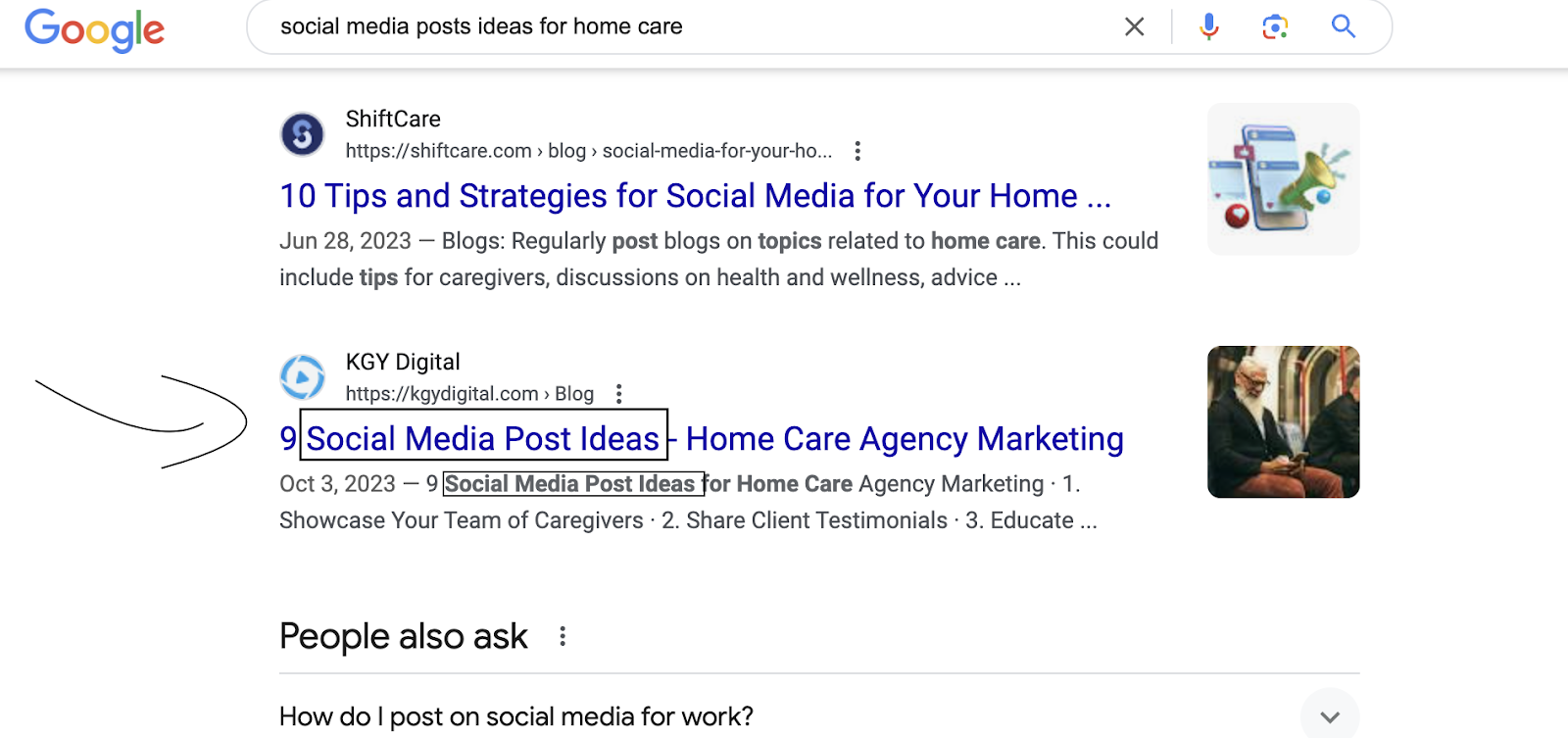
Here’s an example of our article that was ranking #2 for the long tail keyword “social media post ideas for home care.”
Add Images, and include your keyword in at least 1 image ALT tag
Finally, it’s important to for your blog post to have images to keep your users engaged. Take advantage of image alt tags to further optimize for the keyword. Alt tags not only improve accessibility for visually impaired users but also provide search engines with information about the images. Include the keyword in the alt text of relevant images whenever possible.
By following these steps and incorporating the keyword strategically into the title, subheadings, introduction, body, meta description, meta title, and image alt tags, you create a comprehensive optimization strategy. This approach not only improves your blog post’s visibility in search engine results but also ensures that it remains valuable, engaging, and user-friendly for your readers.
Publish your article!!
Once you’re ready, it’s time to publish your article! If you’ve reached this far, you’ll likely be feeling excited about your achievement. Go ahead and hit that publish button and give yourself a pat on the back!
In an upcoming post we will explain how you can publicize your new article through social media, and by asking other websites to link to your content. This will help you get more traffic and potentially increase your search engine muscle.
Tips for Business Blogging Success
Consistency is Key in Blogging for Home Care
Building a successful blog requires consistency. Whether you commit to weekly, bi-weekly, or monthly posts, establish a schedule and stick to it. Consistency not only keeps your audience engaged but also signals to search engines that your website is active and relevant.
Quality Over Quantity
While consistency is important, never sacrifice quality for quantity. Each blog post should provide real value to readers. This could be in the form of practical tips, industry insights, how-to guides, case studies, or thought-provoking analysis. Aim for depth and originality in your content.
Tell Compelling Stories
Humans are wired to respond to stories so don’t try to just write about your products or services. Tell stories in your content that will engage your audience. Avoid being too “salesy” as nobody likes to be sold to. Put yourself in your target customer’s shoes and write content that you would read if you were them.
A Practical Example: This Article on Blogging for Home Care
If you’ve read this far, it means you’re finding some value in this article. This post is an example of the power of blogging for home care. You may have searched online for a related keyword that’s incorporated into this article, or maybe you received the link from someone. Whichever way you arrived here, this article has probably has provided you with some insight into why it’s important to start blogging for your business. You’re reading a practical example of the effectiveness of blogging as a marketing activity.
Our target audiences here at KGY Digital are small business owners and home care agencies. We provide web design and marketing services which are services that these groups are typically looking for at some point in their business journey. If you’re a small business owner, it means we’re doing something right in getting content in front of the right audience.
Measuring Blogging Success Using Google Analytics
Once you have established your blog and begin posting regularly, it’s time to monitor how much traffic is coming to your blog, and which posts are performing well.
Google Analytics is a free tool that will help you to track the performance of your blog and your website overall. With Google Analytics, you can monitor metrics such as total visitors, page views, and average time on page, and more. These metrics provide insights into which topics resonate with your audience and which ones may need adjustment.
Monitoring your analytics also helps you to know which articles to focus on enhancing and improving in order to benefit your business more. Blogging is not a “set and forget” job. Each blog post can be a long-term asset for your business, especially as your monitor and update it regularly.
If a certain blog post is performing well, you may find ways to add contextual advertisements for your services, relevant affiliate links, and updated information so that it remains fresh for years to come. A blog post can have a long lifespan and bring traffic to your business for years to come.
Your web developer can help you set up Google Analytics on your website, to make sure you’re collecting important data on your audience. Need help? Get in touch with us.
Conclusion
In the ever-evolving digital ecosystem, small businesses must adapt and leverage effective strategies to thrive. Blogging, with its ability to boost visibility, engage audiences, and build credibility, presents a powerful opportunity for growth. By consistently delivering valuable content tailored to their target audience, small businesses can position themselves as industry authorities and attract a loyal customer base.
Remember the core principles: know your audience, maintain consistency, prioritize quality, optimize for SEO, and tell compelling stories. With dedication and strategic planning, your blog can become a cornerstone of business, driving growth and fostering lasting connections with your audience.
References:
(a) Blogging Statistics — 31 Stats You Need to Know in 2024. HubSpot Blog. December 21, 2023. https://blog.hubspot.com/marketing/business-blogging-in-2015